‘Can you speak Italian?’ asked my friend doubtfully when I told her that me and my husband were moving to Italy. I assured her we were taking classes, doing online language programmes and using a book with a CD called Italian in Three Months. When I put Disc One into the CD player, I saw myself three months later, sitting in a cafe in Italy, having in-depth conversations with the locals about climate change.
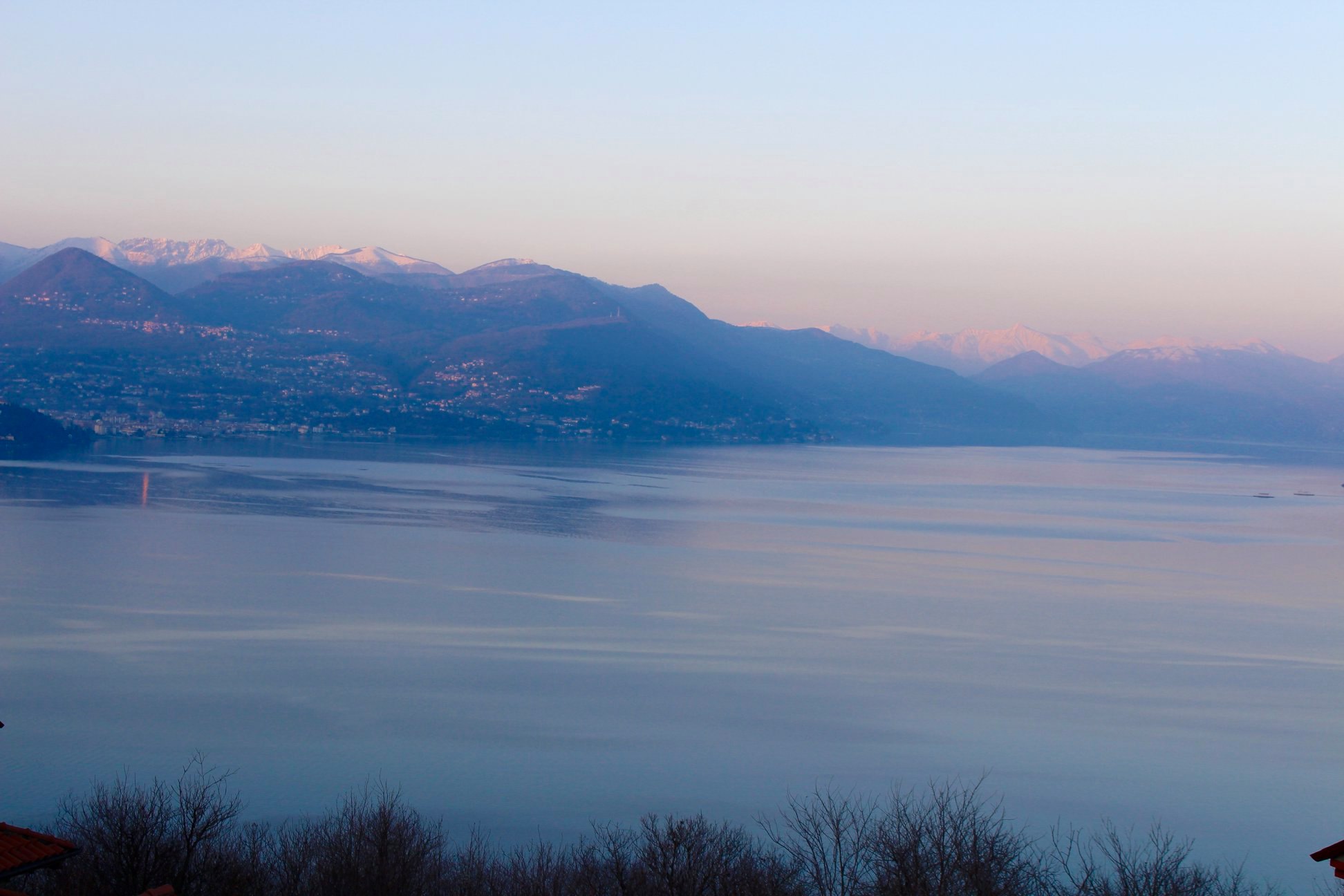
In August 2015, we packed up our London house and said goodbye to our adult children. Accompanied by a basset hound, two cats and my grandmother’s Royal Doulton china, we drove over the Alps and down to Lago Maggiore for our new life in Maggiogrina, an ancient village with a view of the snow-capped Alps. We had bought a hundred-year-old apricot villa with green shutters, overlooking a terraced garden of silver-green olive trees and blueberry bushes.
I couldn’t wait to try out my fledgling Italian on real Italians. We went to the local town and I stopped a woman in the street to ask for directions. In my best Italian, I said: ‘Scusi, dove si trova il mercato settimanale?’ She smiled broadly and fired off a rapid volley of words, which sounded like ‘Iaburrrburraco spollysignal capi strada burra bing.’ ‘Si, si,‘ I replied to her, smiling and nodding. I had absolutely no idea what she had said. ‘Capito,’ she asked. ‘Si, si,’ I lied.
It happened every time I spoke to someone. I would construct a grammatically correct sentence with excellent pronunciation, and then understand only one or two words of the Italian response fired back at me. Sometimes I would attempt a reply, but the person would look blank and say ‘non ho capito’. The Italian in Three Months course had equipped me to correctly ask for a cappuccino and have a few one-sided conversations.
It is well known that Italians speak at high speed, making it harder to pick up what they are saying. The only time I could really understand the conversation was listening to religious programmes where people talk very slowly, especially when they are praying. But it wasn’t exactly useful for small talk about town. Asking Italians on the street to speak slowly proved challenging. I was sitting outside a café enjoying my cappucino, when a woman I’d never met sat down at my table. Short and tubby, wearing black slacks and a green cardigan, she puffed contentedly on her cigarette, oblivious to the smoke blowing in my face. She started talking very quickly, so I put up my hand. ‘Sono Inglese. Parla lentimente per favore.’ ‘Inglese?’ She stopped mid-flow and thought for a moment. Then continued her torrent of chatter at the same speed. At one point she put her finger to her throat and made several cut-throat gestures. She either didn’t like her coffee or she wanted to kill someone. Maybe me for confessing to being English. After a fifteen minute monologue, she abruptly stopped talking and got up. ‘Ciao’ she said and wandered off.
A major obstacle, for which no amount of Duolingo could prepare us, was local dialects. Imagine a non-native English speaker in Britain mastering Received Pronunciation and ending up in Glasgow. Maggiorgrina had its own dialect, incomprehensible even to Italians who didn’t live there. Secret languages are part of the history of Piedmont, like Tarusc, spoken by the ombrellai, umbrella craftsmen in the nineteenth century. They used their own language, so that no one could steal their ideas. Two hundred odd years later, the people of Maggiogrina found their secret language a useful protection against the invasion of the Inglese.
I’m good at dead languages that nobody speaks anymore. I won the Latin prize at school for being the top pupil in the class. There wasn’t much competition – I was the only pupil. My private school had dropped Latin from the curriculum and my parents wanted me to take it, so the school arranged private lessons. My Latin teacher’s first language was Afrikaans – she had a curious pronunciation for some of the Latin words. Like facio – I do. The a is pronounced as in cat. She pronounced it as in abut. Instead of pronouncing the ‘c’ as ‘ch’, she gave it a hard ‘k’. When she declined the verb fac, facio, etc., it sounded like she was saying fuck, fuckio. I defy any teenage schoolgirl not to laugh at that.
There have been well-documented studies about age making it harder to learn new languages. I can attest to that, but I have to admit I’ve always been useless at languages. I don’t have a good ear for it. An Italian will say ‘occhiali’and I’ll hear ‘occhioli’. My husband finds it much easier, but he has the unfair aural advantage of being a musician, as the people in our village liked to helpfully point out. ‘I‘Il tuo Italiano è pessimo’, they would helpfully point out. ‘Ma tuo marito parla Italiano benissimo.’ I don’t want to split hairs, but these were people who didn’t even know what the English for hello was. Apart from Arturo the builder who said it with a long, slow intonation: ‘Hehloooowa.’ It was the only English word he knew.
I was fluent when it came to talking about food, so visiting restaurants or supermarkets made me feel as though I had achieved something. But if I ever felt any satisfaction over my progress, there was always someone to put me in my place. I was out walking, when an elderly Italian man with a golden retriever on a lead stopped to chat to me. We talked for a couple of minutes, then he asked how long I had lived in Italy. I told him.
‘Four years?’ he said in astonishment. ‘You have been in Italia for four years and your Italiano, it is so bad.’
Use it or lose it is an apt phrase for languages. It is depressing to think that the small ground I gained in Italian will be lost now that we are back in the UK. On top of that, my English has become less articulate. It happened to me before, working with refugees in London prior to moving to Italy – I spent so much of my day speaking through interpreters or using simplified English that my vocabulary shrunk. Fluency in my mother tongue has diminished after spending several years surrounded by people speaking Italian. I was watching the news recently and thought the presenter was giving a report about smiling pirates, until I realised she was saying Somali pirates. Forget Italian, I’m going to English classes. Hopefully, I can start at the advanced level.
 We went to Italy