Feeling rootless and homesick in my Italian dream exile, I was thrilled when someone called Leslie left a note on our car windscreen to say she and her husband Martin had seen our British number plate and would like to meet us. ‘Yaaay! British people, look, they’re British…BRITISH!’ I handed the note to Ian. ‘THANK GOODNESS!
We met Martin and Leslie for a drink at the circolo in the village. They had retired to Italy to run a bed and breakfast. Leslie was sympathetic to my homesickness, and we shared heart-warming stories of insomnia, indigestion and tinnitus. When Martin finished his drink, he held out his glass and shouted in a jovial voice ‘Mr. Secretario’, to summon Antonio, the barman, to get him another one. Martin boasted how he did not speak a word of Italian. Leslie learnt it in the 1960s from the Reader’s Digest ‘At Home with Italian’ course.
The next day Leslie came to the house and invited us to join them for Sunday lunch. The restaurant where we met was a delightful, family-run taverna hidden in the hills behind our village, unknown to tourists. It was typically rustic with red-checked tablecloths and a small menu of dishes cooked by the mama of the proprietor. Martin clicked his fingers for service and told the waiter that polenta was prison food. He laughed uproariously when he found out we were living on a teacher’s pension, and boasted how the bank in Italy could not believe the amount he put into his account every month. He studied the final lunch bill intently, and then divided it between us to the last centesimo in case we had eaten a morsel of pasta for which we hadn’t paid.
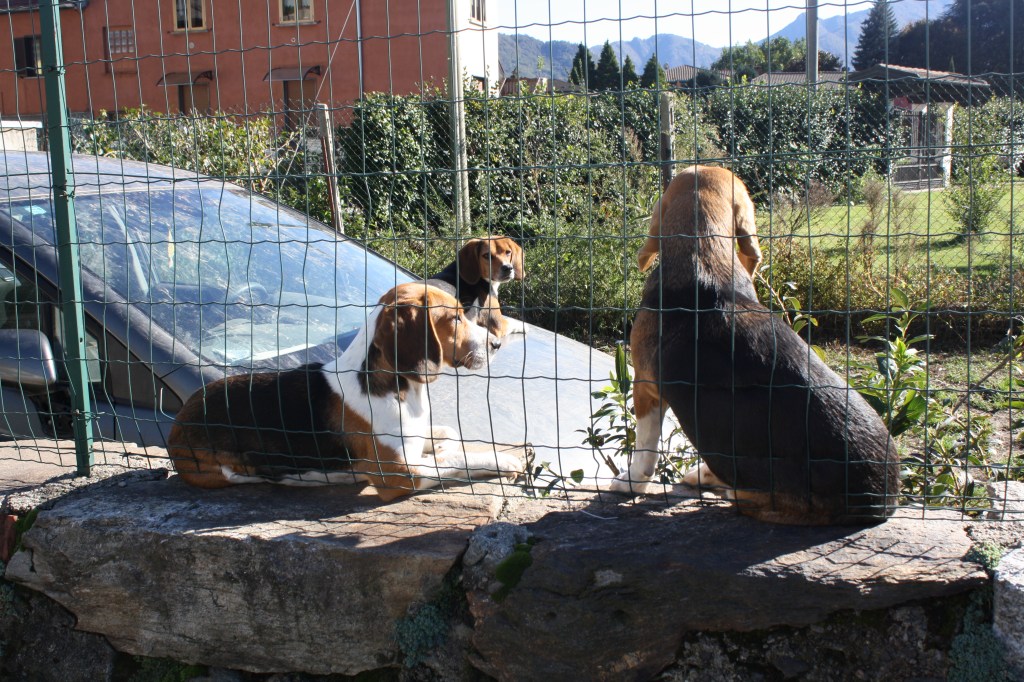
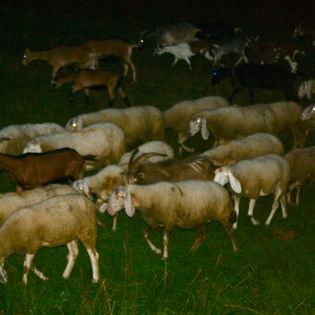
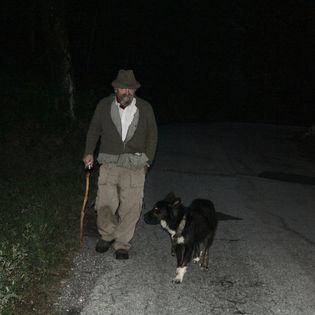
A couple of days later, Leslie appeared at the gate again and invited us for a walk. She had two Beagle dogs with her called Chloe and Pucci. Ian quickly said he had work to do, so couldn’t go walking, but I had no excuse ready. I strolled with Leslie, Chloe and Pucci down the country road behind our house. On our right were the woods, the afternoon sunshine creating dappled patterns on the leaves of the white birch trees. On the left shaggy goats and bony-faced sheep with long ears grazed in the lush green pastures, watched by a shepherd leaning on his crook. ‘Veni qua, veni qua,’ the shepherd yelled at the coarse-haired sheepdogs darting in and out of the animals, nipping at their feet. We stopped to greet him and Leslie chatted to him, her nasal, moany intonation crushing the romance out of the Italian language.
We walked on while Leslie told me the story of her dogs. ‘I love rescuing things,’ she said. Chloe and Pucci had once belonged to a farmer, who left them to fend for themselves on a scrubby piece of land with a few geese and a gigantic pig. Leslie was deeply upset when she saw the filthy and unkempt state of the dogs. One day, she waited for the farmer to come and feed the animals. When he pulled up in his ancient Fiat, Leslie gave him a strong talking-to about the neglect of the dogs, then suggested she adopt them. Leslie took the farmer’s indifferent shrug for assent and bundled the Beagles into her car and back to her house. She named them Chloe and Pucci, and Leslified them. I watched them trotting submissively behind her, their fragranced fur encased in quilted Barbour dog jackets, and wondered if they hankered after their days of unfettered freedom in the farmer’s muddy field.
As we walked along the road, Leslie told me about an English couple who bought a house in the next village, then found themselves in trouble when they couldn’t afford the Italian property taxes. ‘They were teachers, Margot,’ said Leslie, with a knowing look. ‘The wife had to go back to Britain and get a job as a cleaning lady. She was so depressed, she couldn’t stop eating. She had a heart attack and died. It killed her, Margot..… she weighed twenty-five stone when she died.’ I had visions of myself, the poor teacher’s wife, in the kitchen of my lonely villa eating bowl after bowl of pasta followed by mountains of ice cream, hunks of ciabatta showering crumbs on my stained jumper, stuffing my face until the chair I was sitting on broke with my weight.
‘Poor woman.’ I said. ‘We do know about our tax liability. We have an excellent accountant here.’ When I got home later that day, I told Ian we needed to get an accountant as soon as possible.
‘Can you stop tapping that umbrella as you walk Margot. It’s making my tinnitus worse.’ Leslie said testily.
We went through Leslie’s village on the way back and she invited me for a cup of tea. Stabbing aggressively at the teabag with a spoon, she mentioned a news item she saw about refugees coming over in boats to Lampedusa. ‘They’ll overrun Italy the way they have Britain,’ she said. ‘Even the coloured girl reporting said it was a problem.’
We stopped answering Martin and Leslie’s phone calls. Even my desperation to spend time with British people couldn’t dull my senses enough to stomach their company. They turned up at our house one morning and rang the gate bell. Ian glanced out the kitchen window. He flung himself to the ground as though he had been shot. ‘It’s Martin and Leslie,’ he hissed. ‘Get down’. I ducked behind the kitchen counter. Ian crawled along the floor, out the kitchen and past the sitting room windows. When he reached the staircase, he ran up to the tower room and hid.
Martin and Leslie did not put me off wanting to meet other British expats. I just needed to find ones with whom I had more in common. We were sitting on a bench by the lake in Stresa when a couple in their forties came down the path towards us, wearing matching striped tee shirts, beige slacks and straw boaters. The dead giveaway was the neat white socks framed in sturdy leather sandals. ‘They’re British.’ I whispered to Ian. We greeted them, and they told us they had a big villa and garden in the hills above Stresa, where they had moved from London to set up a business running yoga retreats.
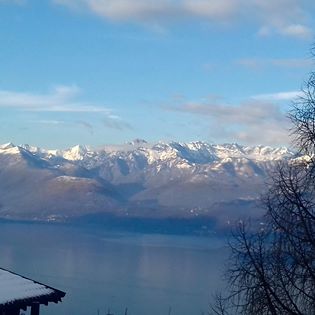
When we arrived at their villa, we removed our shoes before being led into their sparsely decorated living room. Julian made coffee in the spotless kitchen, while Alice led us out to the verandah, with breath-taking views of the lake and Alps. I had brought a ginger cake, but Alice told me they were gluten-intolerant.
‘Would you like oat, almond or soya milk?’ Julian, as he brought a tray out onto the balcony. ‘We’re dairy intolerant,’ he added. Julian may have been allergic to dairy, but I was alternative-milk intolerant, so I opted for no milk. I took a few sips. It was undoubtedly the worst ‘coffee’ I’d ever tasted. I was certain that no coffee beans had been involved in the production of that dismal, greyish liquid sitting like a watery bog in my cup. When Julian said that they were both allergic to caffeine, I knew it was a coffee substitute. Almost criminal in a country that produces Illy coffee.
Julian passed around a plate of wheat-sugar-dairy-flavour-free biscuits. It was like joylessly biting into bits of gravel. A lucky opportunity presented itself when Alice went to the loo at the same time as Julian disappeared into the kitchen. I only had a moment, so acted quickly. I emptied the contents of my coffee cup into the nearest flowerpot, then slung the biscuits over the verandah railings into a clump of dense bushes, hoping they would be eaten by a squirrel before they were discovered. Alice and Julian did not seem to find their eating habits at odds in a country where everyone smoked, drank heavily caffeinated coffee and guzzled enormous quantities of cheese and cured meat.
After we had been there for an hour, Alice glanced pointedly at her watch. We took our cue and stood up to go. As we were leaving, we invited them round to our house for tea. ‘I’m afraid we can’t do that,’ said Alice. ‘We’re allergic to cats.’ I inwardly sighed with relief.
We may have shared the same passport as Leslie, Martin, Alice and Julian, but we would never have been friends with them in Britain. All four of them supported Brexit, despite the obvious advantages they had enjoyed from being part of the EU. The solution to my homesickness clearly did not lie with all British people.
The man picks up an aubergine and studies it intently. He turns it over in his hand and with his thumbs, gently presses the dark purple, outer skin. He lifts it towards the light and down to his nose to smell it. He nods, hands it to the woman across the boxes of vegetables and she puts it into a bag for him.
We are at the fruit and vegetable stall in the Stresa Friday market. All the produce is Italian in origin and not flown from the other side of the world. It’s a matter of nationalistic pride, but the benefit to the fight against global warming is welcome. The stall is run by Cristina, a slim, middle-aged woman, with neat brown hair and glasses. Her bookish demeanour contrasts with her sister-in-law, who is wearing a low-cut, cleavage outing top and tight jeans with spangles and sparkles. Her big eyes are adorned with bright blue eye shadow and her long frizzed hair is dyed silver-white.
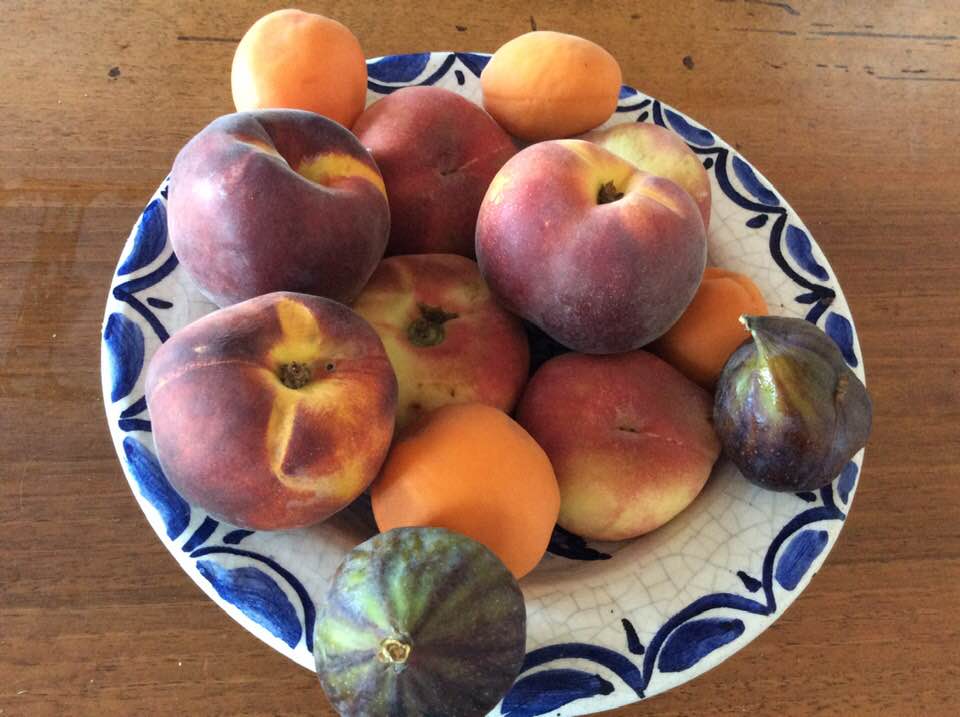
Cristina and her sister-in-law always help us pick out the best produce. When we get home, we lay out our spoils on the kitchen table. The basil gives off a heady scent when it is taken out the paper bag. The carrots smell earthy with a flavour from some forgotten recess of childhood, before fruit and vegetables were packaged into sterility by long flights and plastic wrapping. When I bite into the plump peach, the juice runs down my arm. Sweet oranges evoke memories of taking fruit from the tree of an orchard on my uncle’s South African citrus farm. We spent so many years eating flavourless and odourless fruit from supermarkets in London. To eat the best of them in the warm sun is like being reborn.
For lunch we have cheese and salami bought that morning from the stall run by a cheerful couple in their seventies. When they threw back their heads and laughed uproariously at the way I pronounced the cheeses, it was hard not to notice they only had about five discoloured teeth between them. Their cheese is sensational; creamy mozzarella, crumbly parmesan with a salty tang, pecorina with walnuts or pears and the soft cheese ‘bastardo’, called that because it is made with mixed milks.
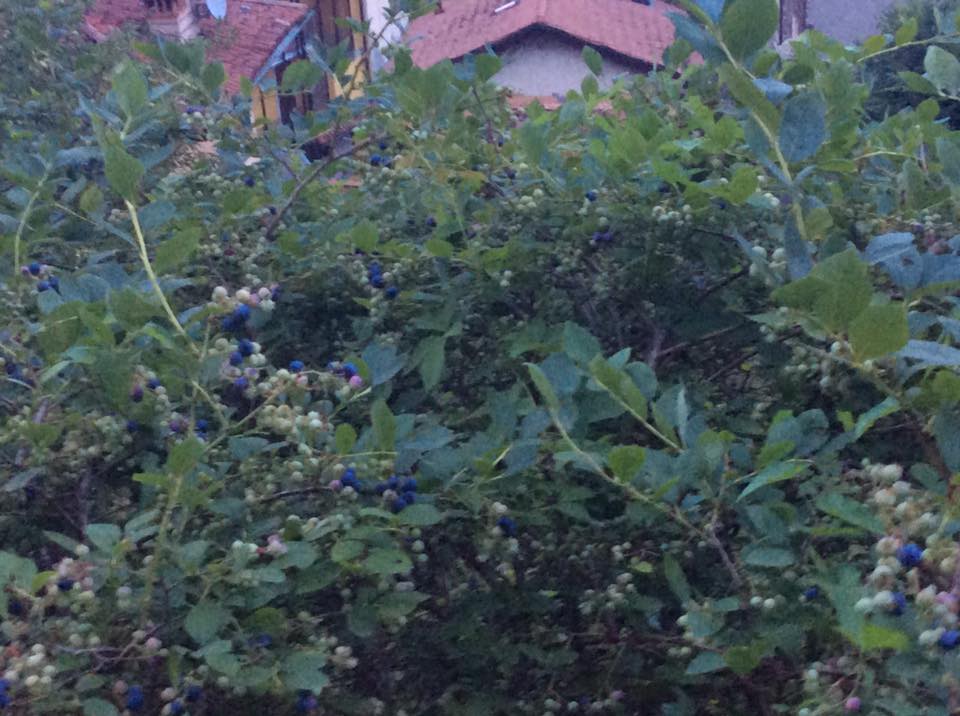
One thing we don’t have to buy at the market is blueberries because we have bushes of them on the terraces. As the hot humid haze of July reaches its zenith, dissipating winter’s arthritic aches with its intense, sauna-like warmth, our blueberries burst into fruit. When we came to look at the house, the previous owner, Gianni, pointed to them. ‘Mirtilli!’ he said. We thought he meant myrtle trees. We looked up the translation of ‘mirtilli’ one day and discovered we had bypassed a goldmine of blueberries our first summer.
Gianni stopped his Vespa outside the gate one day on his way down from his allotment backing onto our garden. He wanted to know if the blueberries were ripe. We told him they were under a siege of overgrown grass, which needed to be cut by a strimmer. When ours broke, we tried using a scythe we found in the garage, but hours of toiling away with no noticeable difference did not have the charm of a Thomas Hardy novel.
Gianni went off and came back with a petrol strimmer tied to his back. We thought he had brought it to lend to us, but he set off up the terraces and for two hours, dripping in sweat, cut the grass, including the waist-high weeds preventing access to the blueberries. We offered to pay him, but he brushed us aside and asked if he could have a few blueberries instead. He appeared later that day with a huge plastic vat and spent an hour plucking the fruit. When I went to pick some the next morning, all the plump, juicy, blue-black ones had gone.
Gianni appeared at our gate a few days later with his plastic vat and said he needed more blueberries to make jam, and disappeared up the terraces to pick the new ones that had ripened. He returned to our house that afternoon with his nephew and wife. Gianni said he had brought his nephew’s Canadian wife to explain in English how to make the blueberry jam. Out the blue, he asked if we wanted to buy his petrol grass strimmer for €450. We thanked him but declined. We couldn’t afford it and weren’t keen to have a combustible tank of petrol strapped to our back in the hot sun.
We bumped into Gianni’s nephew and his wife in Stresa the next day. ‘We were very embarrassed by Gianni.’ said the nephew’s wife. ‘He pretended he wanted to show you how to make jam, but he just wanted to sell you his strimmer. We didn’t know he was going to do that. We’re sorry. It made us uncomfortable.’
‘Si, mi dispiace,’ said her husband, nodding earnestly. We tried not to laugh.
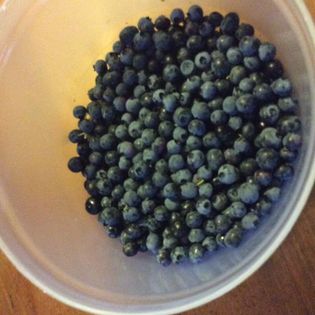
When the next batch of blueberries ripened, I rose at eight o’clock ready to grab them before Gianni. But he had already plundered the bushes. I wanted to tell him to stop taking our blueberries, but we were worried he would gossip to everyone in the village about how stingy the English were. As soon as the next crop appeared a few days later, I was up at the crack of dawn rushing up the slopes with my bowl to get there before Gianni. He was nowhere in sight. I collected a mountain of berries, waving away mosquitos and avoiding bumble bees diving towards the fruit like buzzing yellow and black missiles.
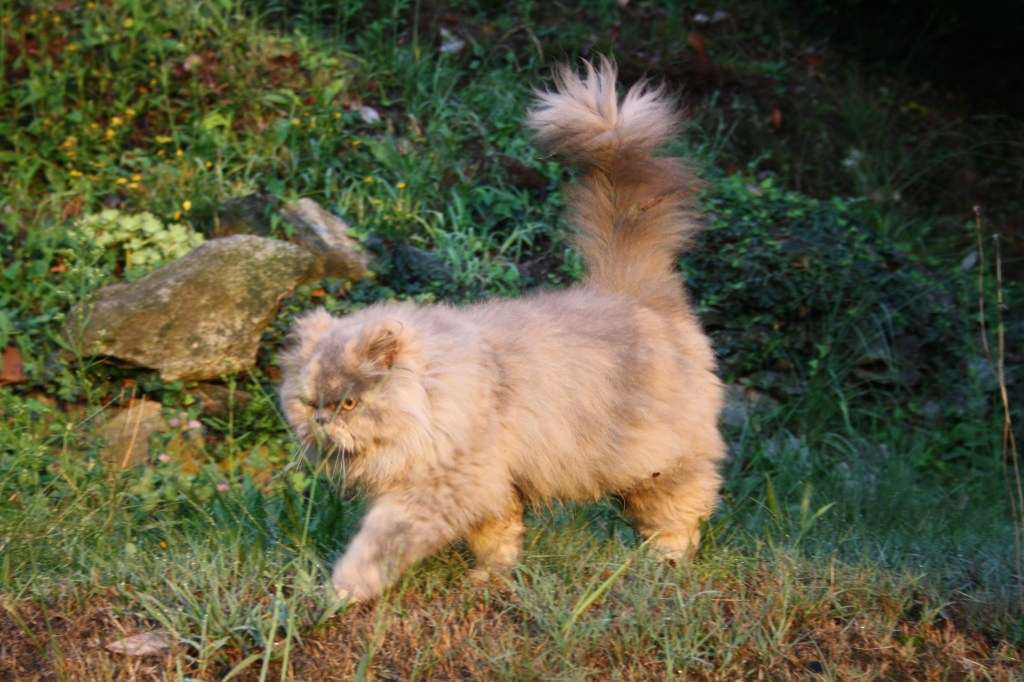
Holding my bowl of blueberries, I looked across at the mountains and was treated to a glorious panorama of pink, red and orange streaked across the sky, as the golden ball of the sun rose over the peaks. I heard the melodic sound of a blackbird and saw him pecking the lawn below. Another blackbird flew down to join him. As he was coming into land, out of nowhere Meschia the Persian cat leapt into the air and caught the bird mid-flight. I dropped my bowl of blueberries, shouted at the cat and chased after her, but she ran off with her prey. Later I saw the bird on the ground under the apple tree, perfectly intact, but dead. I hated it when blackbirds were killed by the cat. I loved waking up in the early mornings to hear the dawn chorus of blackbirds serenading the morning air. They are the jazz musicians of the bird world. They don’t have just one bird song – they constantly improvise and change their tunes.
Later that day I was walking up the steps to the tower room, when I heard the sound of leaves rustling. I glanced over to the blueberry bushes which appeared to be moving. The branches were shaking and for a moment I thought a deer had left the forest and come into our garden. Then a voice said ‘Buongiorno’ and Gianni’s face popped out from behind the foliage. ‘Buongiorno,’ I replied and smiled to myself because I knew he would have slim pickings. He gave up after that.
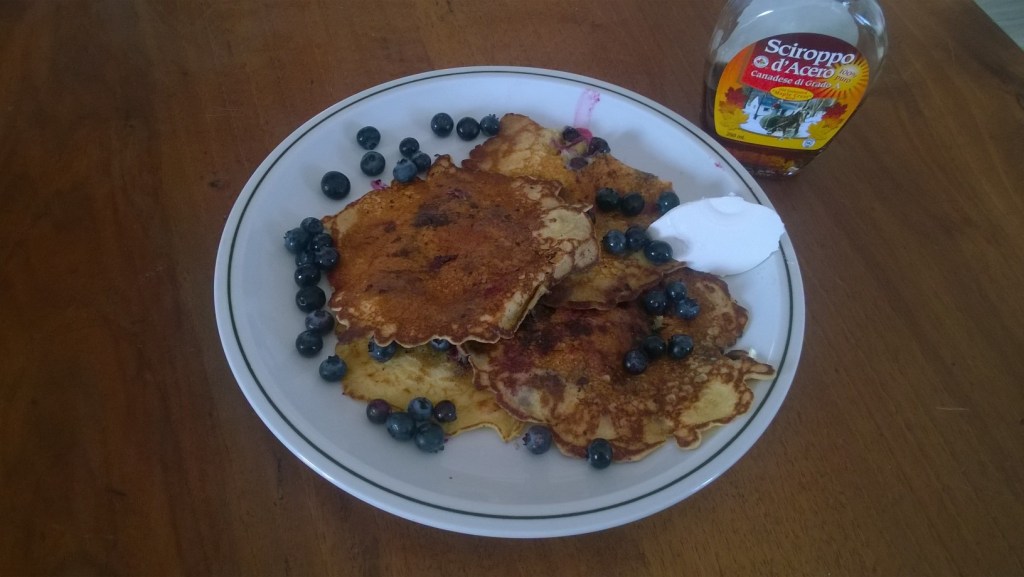
For the rest of the season, we had plenty of blueberries. I froze the berries, made cakes with them, whipped up tarts and ice cream. I gave a bowl of blueberries and some of my berry cake to a French family staying in our holiday flat. They offered us a piece of the tart they made from the fruit I gave them. I took some blueberry cheesecake to ninety-year old Annalisa. I knocked on her kitchen door, and she shouted: ‘Chi è la?’ ‘L’inglese’ I replied.
We walked past Gianni’s vegetable allotment behind the house one day and peered through the iron gate.
‘Hang on a minute,’ Ian said. ‘Aren’t those blueberry bushes?’
‘There’s at least eight of them.’ I replied. ‘Why was he nicking all our blueberries?’
From May to October ticks lurk in the long grass in our garden. One evening after supper, our ginger cat sat on my lap at the kitchen table. He is called Fatty le Ginge, but too embarrassed to ever say his real name, we gave him an imaginative nickname, Ginger. I was stroking his head when I felt a lump on the side of his face. I ran my finger over the swelling thinking it was a small cyst. Ian wandered into the kitchen, peered closely at Ginger and said it was a tick. He found a Christmas cracker magnifying glass in the kitchen drawer and handed it to me. I could see legs writhing on either side of a beige/grey, blood-saturated body. I threw the cat off my lap and ran to wash my hands.
We were surprised a tick had managed to latch onto the cat, because we regularly doused the cats with flea and tick treatment, but this one must have been resistant. We searched the internet for information on how to pull out a tick. Armed with the requisite knowledge, I held Ginger, keeping the side of his face with the latched-on parasite as far away from me as possible, while Ian grabbed hold of the tick with a pair of tweezers and pulled hard. It didn’t budge. He pulled again, sweating with the effort. The tick remained embedded.
We tried several times, then went up the road to fetch Fatlinda, a good-natured Albanian woman in our village, who ironically, is fat. We were told in a conspiratorial whisper by one of our neighbours that Fatlinda weighed 120 kg. Fatlinda has twelve wild cats living in the passage leading up to her front door. She is one of the gattare, women in Italy who look after stray cats. Italy has huge numbers of feral and stray cats (gatti liberi) with around 200,000 being abandoned every year. There is a retired woman in Milan, who spends her monthly pension of €1500 on cat food for 120 stray cats. She and her husband live on an almost starvation diet to save enough money for the animals. Albertina leaves her house at six o’clock every morning, her Fiat loaded with seventy tins of cat food, three kilos of cat biscuits, two litres of milk and fifteen litres of water and drives around the city feeding her cats.
Fatlinda came back to the house with us and lumbered into our kitchen. ‘La tua casa non è pulita,’ she said, pointing to the unwashed dishes in the sink. Which is virtually a crime in Italy. She waved the tweezers away, put her hand behind the cat’s ear, made a sharp, twisting movement and out came the tick. We dropped it into a jam jar of Limoncello, the only alcohol we could find in the house. The internet had instructed us to dump the removed tick in alcohol. We rubbed some limoncello on the cat’s skin where the tick had been.
The next morning, I looked in the bathroom mirror and saw something on my neck. I wasn’t wearing my glasses, but I could see ovular outlines and feel a small lump. I panicked and frantically rubbed limoncello on it. Ian came into the bathroom. ‘I’ve got a TICK,’ I said, frantically pointing to my neck. ‘A TICK. On my NECK. I don’t know how long it’s been there. If it’s been there for twenty-four hours, I’m definitely getting Lyme’s Disease.’ Ian stared at it. ‘That’s a skin tag’.
A few days later, Ian complained about an itchy bite on top of his head. It had been there for a week, but now he felt unwell. He asked me to look at it. I got up from my chair and went to where he was sitting on the sofa. Looming over his head, I saw a boil-like swelling with a necrotic black scab ringed by an angry red rash. ‘Does it look bad?’ Ian asked. ‘Nooo,’ I lied, recoiling from it. ‘But you should get it checked out by the doctor.’ Thanks to my extensive consultation with Dr. Internet, I knew it was more than likely an infected tick bite.
We went to town that afternoon and showed the bite/boil to the pharmacist. She examined it, then shook her head and told Ian to see the doctor as soon as possible. He went to Dottore Ferrari, an energetic man with black hair and thick glasses that made his eyes look large and permanently surprised. He told Ian he didn’t have cancer but a tick bite and sent him away with a course of anti-biotics. Whatever ailment you consulted Dr. Ferrari about, he would always say ‘non è cancro’.
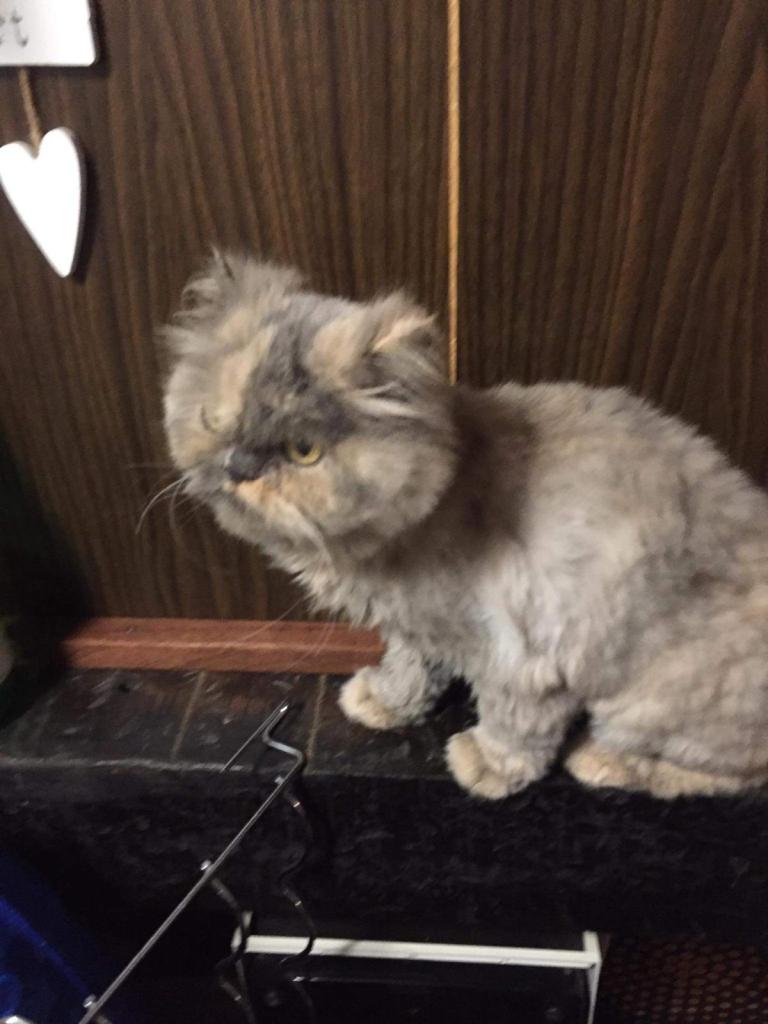
Meschia, our Persian cat, manages to avoid ticks. The main problem is keeping her long hair under control. We should brush her several times a day to prevent her fur from becoming matted, but she viciously scratches us when we try. The fur gathers into large, knotted balls which house every flea in Maggiorgrina and inflame her skin. We had seen a veterinary surgery in a town further up Lago Maggiore and taken the phone number down. We phoned the vet and told him about the problem with Meschia’s fur.
‘Is he a good cat or a bad cat?’ asked the vet, speaking English with a heavy Italian accent.
‘She’s a bad cat,’ said Ian.
‘Ok I give her injection.’
Later that day we drove to the vet. As we approached the door of the surgery, a man in his sixties came out holding a syringe in the air, pumped and ready to go, a drop of liquid pulsing out the top of the needle. Syringe aloft, he went straight past us and charged down the road.
‘It’s a good thing he didn’t trip and plunge the syringe into one of us,’ said Ian, looking at the man running down the road.
I followed Ian’s gaze. ‘Is he the vet, do you think?
It was our turn and we followed the vet into the consulting room. Crammed with antiquated equipment, it looked like a television set from a programme about vets in 1960. There was a machine with an open phial of blood resting on it, from a previous patient/pet. The vet went over to a dresser to get the stuff to sedate Meschia. He opened a drawer with medicines in it, which seemed to have other things in there as well. It reminded me of our drawers at home full of raw plugs, screws, pencils, batteries and old phone chargers. The vet did a thorough shearing job on Meschia. We watched as lumps of grey fur fell to the floor until there was only a few tufts left around her face. Afterwards Ian pulled his wallet out to pay, which surprised the vet. He told us we only had to pay if we wanted or pay some other time like most of his customers.
When we came home, Ginger didn’t recognise Meschia. As she came through the door, his hair went on end like a cartoon cat. Meschia was dozy from her anaesthetic and crawled around the floor in a drunken stupor. Like the time she was tumble-dryed. I had put a pile of clothes in the tumble dryer and was distracted by a phone call. When I came back to the kitchen and turned on the machine, it made a strange thumping noise, a rhythmic thwack on every turn. I wondered if a pair of trainers had been left inside or if it was an electrical fault. I turned the machine off and opened the door. Meschia staggered out. She walked slowly through the kitchen swaying slightly, as though she had taken a swig too many from the gin bottle. She had climbed into the dryer and hidden under the clothes while I was out the room on the phone. She recovered after a few minutes. After that I always checked through the clothes in the dryer before I started the machine.
Easter traditions in Italy are similar but more different than I expected to the ones in Britain. In the run-up to Easter, churches collect foliage from olive trees for Palm Sunday. Piles of branches with silver grey leaves lie in the entrances of the local parish churches. Instead of a Palm cross, parishioners are given a twig of olive tied with a red ribbon. Our neighbour, Gianci, sweetly brought us one to bless our house.
Living in a Catholic country, we are reminded that Easter is of course, predominantly a religious festival, the most important time of year in the church calendar. Apart from church services, there are rituals, vigils and parades in the streets. In Britain, we form orderly queues to make a pilgrimage to the shrine of the paint section in B&Q.
Here in Italy, local priests go round and bless all the houses in their parish. People hang yellow ribbons and flowers on their front doors. The priest never made it to our house, because we forgot to put a yellow bow on the front door. Or maybe it’s because we’re not Catholic.
Given that 93% of Italians are Catholic, I was surprised when Jehovah’s Witnesses turned up at our gate. (I did some research and found out there are 420,000 Jehovah’s Witnesses in Italy). I greeted the two men wearing ties and suits sporting lapel badges with JW.org on them. They were holding clip boards and pamphlets and I thought they were local reps from a political party because of their corporate disguise. By the time I realised who they were, they were well into their earnest lesson on my salvation, so it took a while to get rid of them. The next time they visited our house, I was prepared and said to them: ‘Sono Inglese. Non parlo Italiano.’ Which isn’t entirely untrue. They left immediately.
In the run-up to Easter, the shops display a type of panettone in the shape of a dove, la colomba di Pasqua, a soft cake with an orangey flavour and almond topping. Easter eggs dominate the supermarket shelves – mass produced in the same oval shape. Some of them are huge, the size of a toddler. Italians love bright, blingy motifs. It’s hard to buy a pair of jeans without bells, twirls or diamante decorations on them. The Easter eggs with their shimmering expansive wrappings of brightly-coloured foil would probably be seen from outer space of they were placed in the middle of an open field.
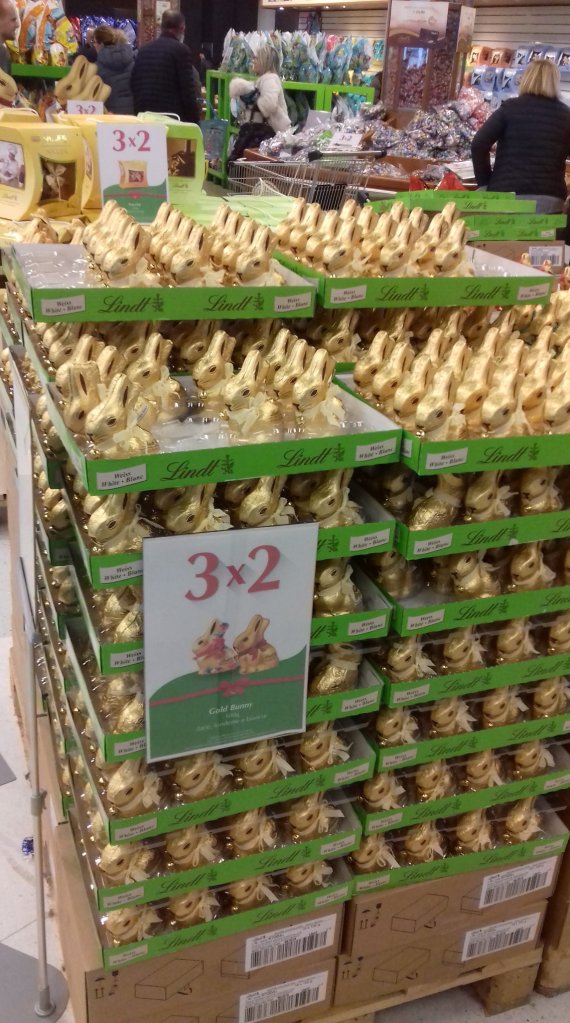
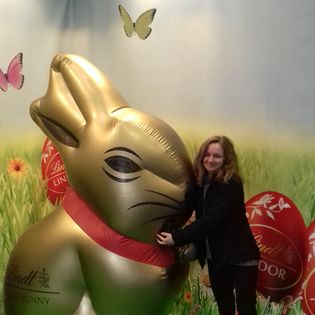
I was shocked to discover that the Easter bunny doesn’t feature in Italian mythology, which means no bunny-shaped chocolates in the shops. All is not lost because we have the Lindt outlet store near Milan. Rows of Lindt gold bunnies and a ten foot one in the entrance are enough to satisfy any need for rabbit-shaped confectionary. And for complete cocoa saturation, their café serves rich hot chocolate that feels like liquid velvet gliding over your tonsils and down your gullet.
The non-appearance of the Easter bunny means no egg hunt on Easter Sunday! When our children were young, we took them to an organised egg hunt at Leeds Castle. There was much excitement as families gathered at the bottom of a small hillock. At the appointed hour, a whistle was blown and all the children ran up the grassy incline with their decorated buckets to find the magical treasure of foil-wrapped, budget Easter eggs hidden under stones and beneath shrubs. I was smiling encouragingly at my kids, when out of nowhere, a trio of middle-class matrons with blowsy hair, hand-knitted jumpers and wellingtons galloped up the slope. Trampling over small children as they swooped and dived, they grabbed the lion’s share of the eggs and tossed them into their voluminous Volvo-sized wicker baskets. Several children that day were inconsolable because they had not managed to pick up a single egg, thanks to the greed of the green wellie brigade.
For our first Easter in Italy, I went searching for a leg of lamb. I scoured the supermarkets to no avail. There was lamb but not in the form of a leg – chops, cutlets, lamb steaks. Someone suggested the butcher in Stresa. He assured me he could get lamb if I paid 35 EUR up front. When I went to collect it, I was sorely disappointed at the sight of the scrawny joint. I took it as it was the only option. But I knew it would never transform onto the platter into a rich, succulent Welsh roast lamb with a sprig of rosemary on top. Not least because I could have sworn it was goat.
Spring is my favourite season on Lago Maggiore. The dawn chorus of birds is so vibrantly loud, it wakes us up. April is a symphony of four seasons colliding – the weather has the warmth of summer, but there is still an icing sugar dusting of winter snow on top of the mountain peaks. On our evening walks, we trample ankle deep in piles of copper autumnal leaves and spiky chestnut husks covering the soft earth of the forest floors. Above us, the luminous green shoots of spring appear on branches.
When we walk down to Stresa, water from melted snow streams and gurgles in gutters on either side of the road. A profusion of primroses, snowdrops, crocuses and other Alpine spring flowers grow out of banks of earth and garden walls, a panorama of unfolding floral beauty changing almost daily. We often stop to admire a villa with jasmine creepers adorning the front fence, small white star flowers nestling among dark green leaves. As we stand there, its delicate fragrance drifts towards us. I love the huge magnolia trees in gardens and parks around the lake with their creamy petals silhouetted against the blue-black of the mountains like translucent pink and purple seashells.
Behind the house, lush green pastures abundant with yellow buttercups provide a perfect platform for the humming song of crickets. But the most enchanting is the cuckoo. Before we moved to Italy, I had only ever seen a cuckoo popping out a clock. In early spring around the lake we hear them morning and evening in the woods. I heard one sing across the valley that sweeps down to the lake. I stood completely still for a few seconds, transfixed by the gentle delicacy of the sound.
I love the fragrance of an Alpine spring – the herby, cut-grass aroma of rich pastures with a heady rush of honey-suckle perfume and tang of wildflowers. I am like a scent hound, taking deep breaths and sniffing the air, trying to imprint it on my memory, so that when we no longer live here, I can still smell it.
It can be daunting living in a country where you don’t speak the lingo. Language is an intrinsic part of our identity, and essentially how we engage with the world. Living in Italy, especially in the early stages, I could only pick up the odd word in conversations around me in public places, so I would switch off and sink into my own detached world, cut off from everyone else. On my first visit back to Britain, it was delightful to hear snatches of dialogue on the train, in restaurants and shops. Walking into a café one day, I heard two women at an outside table discussing Mendelssohn’s ‘Midsummer Night’s Dream’. I ordered an English breakfast, then settled down to surreptitiously listen to the other customers – I had high hopes for another arty, intellectual exchange. There were two young men at the table next to me, who appeared to be having an intense discussion, so I tuned in. ‘But was it an audible fart?’ one of them asked the other earnestly.
In our first few months, our limited Italian made it difficult to navigate practical necessities. We were out of our depth shopping for anything more technical than food and clothes. We visited a media chain store to buy a new mobile phone. Paola, the shop assistant, showed us a collection of smart phones in a display cabinet. Speaking in Italian interspersed with random words of English, she explained how the various phones worked and the different contracts. We simply couldn’t understand what she was saying. Eventually she sighed, shrugged, shook her head and put all the phones back. Then her face brightened and she instructed us to follow her to the back of the shop. There in an abandoned corner was a phone on a shelf. ‘Is good for you. We calla questo…eh.. ‘Old Man’ telefono,’ she said, pointing to the obsolete, no frills cell phone that nobody under forty would be seen dead with. Paola was relieved when we agreed to buy it, especially as it was nearly lunchtime, and it is never advisable to get between an Italian and the sacrosanct midday meal. She practically pushed us out the shop with our new Old Man phone.
Visiting the DIY superstore proved equally challenging. We stared blankly at the shelves of paint tins, unable to recognise any brand names. We bought a large pot of white emulsion, and the next day, set about painting the kitchen. The thin, watery paint dripped down our arms as we lifted the brush up to the wall. After three coats, the wall was a greyish/white colour with streaks and patches. The paint we had bought was clearly whitewash.
We went back to the shop and asked at the front desk if anyone working in the shop understood English. They told us that Piero spoke very good English and summonsed him over the tannoy. With his piercing green eyes and thick black hair, Piero looked like a movie star. It confirmed my notion that there were certain images of Italians I found incongruous, like working in a DIY shop. The customers seemed out of place as well, strutting down the aisles in their designer jeans and jackets, stylishly loading bags of cement and spirit levels into shopping trolleys. Despite the glowing endorsements from his colleagues, Piero’s English was about as proficient as our Italian. He only knew three English phrases which he recited proudly: ‘Today is Monday’, ‘What is the time’ and ‘Are you happy?’ With the help of Google Translate on his phone, Piero found the paint we needed. We left with two tins of emulsion and a new word to add to our Italian lexicon – antimuffa. Not a political organisation but the Italian word for anti-mould paint.
Lack of language literacy can be a real problem in the context of medical diagnosis and treatment. I found it unsettling going to the doctor, struggling to explain my symptoms, before being handed a piece of paper for medication I’d never heard of, with confusing dosage instructions. Before we lived in Italy, we stayed in a damp mill house near Pisa one April. Our son was ten at the time. He had a cold which turned into a nasty, persistent cough. One morning he woke up with a high temperature, so we went to the nearest Croco Rosso centre. They told us to go home and wait for them. Shortly afterwards, an old Fiat Panda came bounding up to our house. The driver was called Fabbio. With a jagged scar across his Adam’s Apple, hoarse voice and pock-marked skin, he could have walked a film role about the mafioso.
Fabbio squeezed us into his car and took off at about ninety miles an hour, racing down the winding road to Pisa. He deposited us at the entrance of the casualty department at Pisa Hospital. We walked through the sliding doors into the waiting room, where a social gathering appeared to be in full swing. Groups of people standing around, chatting loudly and laughing, – it was hard to tell who the patients were. Everybody was dressed up, including the ones on trolleys, their leather designer shoes poking out the end of the ribbed hospital blanket. There was an elderly Italian woman stretched out on a trolley. Her family were crowded round her bed, shouting at top volume to each other and the A&E doctor. No one noticed when she feebly raised her trembling hand and repeatedly opened her mouth to speak.
A woman doctor (dottoressa) in a white coat called us into a side room and listened to John’s chest. She said it was ‘clean’ and we could go. As we were leaving, I patted my abdomen to indicate that he had a stomach ache as well. The dottoressa jumped up from her desk, ‘Stomach pain,’ she repeated several times. She called one of the nurses, who collected John and left the room with him. The dottoressa didn’t speak English, so couldn’t explain why they were taking our son away. We waited anxiously in the reception area until the dottoressa called us into her office. The nurse brought our son back, accompanied by a radiographer who could speak English. He explained that they had done scans and x-rays of both his chest and stomach and were waiting for the consultant to look at them.
I went out to get a takeaway coffee and as I was returning, I saw the whole family being loaded into an ambulance outside the entrance to the A&E. I dropped my coffee on the pavement and raced to reach the ambulance just as they were closing the doors. Our son was being transferred to the paediatric department on the other side of the hospital grounds. We were led up to the second floor into the Dipartmento Paediatrico (If I had known that all I had to do was add ‘o’ to the end of the English word, I wouldn’t have found Italian so hard!). A startlingly attractive young paediatrician with glowing olive skin and dusky eyes listened to our son’s chest, looked at his x-rays and said he had pneumonia. He was weighed and given a prescription for anti-biotics. Although the care was excellent, our son was given more tests than he needed like the stomach x-rays, because we couldn’t explain the symptoms properly, and the Italian hospital staff wanted to make sure they had covered every possibility.
There was a hospital in a town on the other side of the lake from our village. Directly on the waterside, inpatients would have had a view of the lake and mountains from their hospital bed. We walked past it one day and Ian said. ‘When I’m old and about to die, I want to be in this hospital in Omegna looking out at the lake with a nice Italian nurse holding my hand.’
‘I’d rather be in an underfunded, overstretched NHS hospital, lying on a trolley in the corridor waiting hours for a bed.’ I really meant it. I simply could not imagine having a stroke or fall, and in my frailty, unable to understand what was being said to me. Hearing ‘signora, signora, iaburrrburraco spollysignal capi strada burra bing’ as I croaked my last few breaths.
‘Can you speak Italian?’ asked my friend doubtfully when I told her that me and my husband were moving to Italy. I assured her we were taking classes, doing online language programmes and using a book with a CD called Italian in Three Months. When I put Disc One into the CD player, I saw myself three months later, sitting in a cafe in Italy, having in-depth conversations with the locals about climate change.
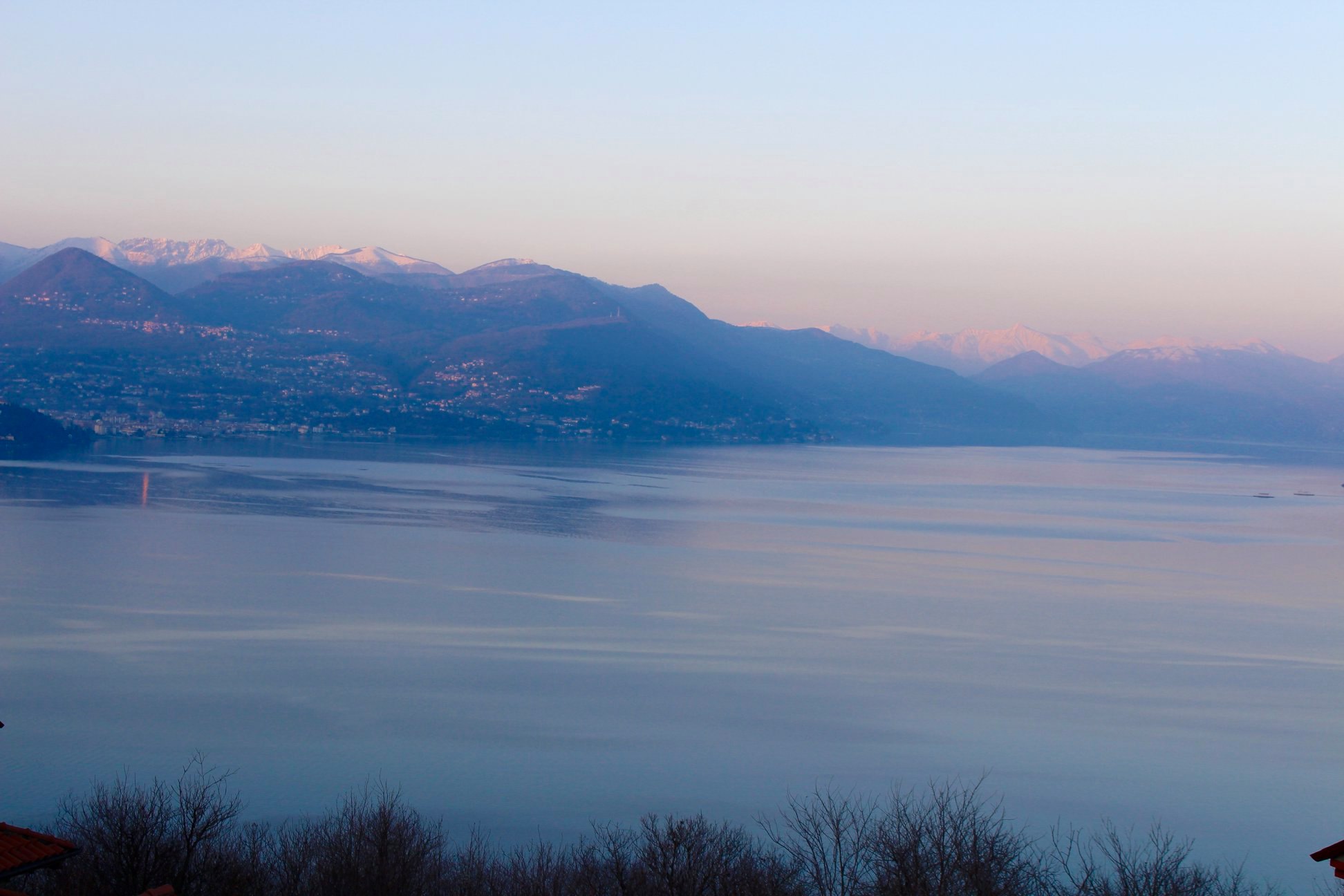
In August 2015, we packed up our London house and said goodbye to our adult children. Accompanied by a basset hound, two cats and my grandmother’s Royal Doulton china, we drove over the Alps and down to Lago Maggiore for our new life in Maggiogrina, an ancient village with a view of the snow-capped Alps. We had bought a hundred-year-old apricot villa with green shutters, overlooking a terraced garden of silver-green olive trees and blueberry bushes.
I couldn’t wait to try out my fledgling Italian on real Italians. We went to the local town and I stopped a woman in the street to ask for directions. In my best Italian, I said: ‘Scusi, dove si trova il mercato settimanale?’ She smiled broadly and fired off a rapid volley of words, which sounded like ‘Iaburrrburraco spollysignal capi strada burra bing.’ ‘Si, si,‘ I replied to her, smiling and nodding. I had absolutely no idea what she had said. ‘Capito,’ she asked. ‘Si, si,’ I lied.
It happened every time I spoke to someone. I would construct a grammatically correct sentence with excellent pronunciation, and then understand only one or two words of the Italian response fired back at me. Sometimes I would attempt a reply, but the person would look blank and say ‘non ho capito’. The Italian in Three Months course had equipped me to correctly ask for a cappuccino and have a few one-sided conversations.
It is well known that Italians speak at high speed, making it harder to pick up what they are saying. The only time I could really understand the conversation was listening to religious programmes where people talk very slowly, especially when they are praying. But it wasn’t exactly useful for small talk about town. Asking Italians on the street to speak slowly proved challenging. I was sitting outside a café enjoying my cappucino, when a woman I’d never met sat down at my table. Short and tubby, wearing black slacks and a green cardigan, she puffed contentedly on her cigarette, oblivious to the smoke blowing in my face. She started talking very quickly, so I put up my hand. ‘Sono Inglese. Parla lentimente per favore.’ ‘Inglese?’ She stopped mid-flow and thought for a moment. Then continued her torrent of chatter at the same speed. At one point she put her finger to her throat and made several cut-throat gestures. She either didn’t like her coffee or she wanted to kill someone. Maybe me for confessing to being English. After a fifteen minute monologue, she abruptly stopped talking and got up. ‘Ciao’ she said and wandered off.
A major obstacle, for which no amount of Duolingo could prepare us, was local dialects. Imagine a non-native English speaker in Britain mastering Received Pronunciation and ending up in Glasgow. Maggiorgrina had its own dialect, incomprehensible even to Italians who didn’t live there. Secret languages are part of the history of Piedmont, like Tarusc, spoken by the ombrellai, umbrella craftsmen in the nineteenth century. They used their own language, so that no one could steal their ideas. Two hundred odd years later, the people of Maggiogrina found their secret language a useful protection against the invasion of the Inglese.
I’m good at dead languages that nobody speaks anymore. I won the Latin prize at school for being the top pupil in the class. There wasn’t much competition – I was the only pupil. My private school had dropped Latin from the curriculum and my parents wanted me to take it, so the school arranged private lessons. My Latin teacher’s first language was Afrikaans – she had a curious pronunciation for some of the Latin words. Like facio – I do. The a is pronounced as in cat. She pronounced it as in abut. Instead of pronouncing the ‘c’ as ‘ch’, she gave it a hard ‘k’. When she declined the verb fac, facio, etc., it sounded like she was saying fuck, fuckio. I defy any teenage schoolgirl not to laugh at that.
There have been well-documented studies about age making it harder to learn new languages. I can attest to that, but I have to admit I’ve always been useless at languages. I don’t have a good ear for it. An Italian will say ‘occhiali’and I’ll hear ‘occhioli’. My husband finds it much easier, but he has the unfair aural advantage of being a musician, as the people in our village liked to helpfully point out. ‘I‘Il tuo Italiano è pessimo’, they would helpfully point out. ‘Ma tuo marito parla Italiano benissimo.’ I don’t want to split hairs, but these were people who didn’t even know what the English for hello was. Apart from Arturo the builder who said it with a long, slow intonation: ‘Hehloooowa.’ It was the only English word he knew.
I was fluent when it came to talking about food, so visiting restaurants or supermarkets made me feel as though I had achieved something. But if I ever felt any satisfaction over my progress, there was always someone to put me in my place. I was out walking, when an elderly Italian man with a golden retriever on a lead stopped to chat to me. We talked for a couple of minutes, then he asked how long I had lived in Italy. I told him.
‘Four years?’ he said in astonishment. ‘You have been in Italia for four years and your Italiano, it is so bad.’
Use it or lose it is an apt phrase for languages. It is depressing to think that the small ground I gained in Italian will be lost now that we are back in the UK. On top of that, my English has become less articulate. It happened to me before, working with refugees in London prior to moving to Italy – I spent so much of my day speaking through interpreters or using simplified English that my vocabulary shrunk. Fluency in my mother tongue has diminished after spending several years surrounded by people speaking Italian. I was watching the news recently and thought the presenter was giving a report about smiling pirates, until I realised she was saying Somali pirates. Forget Italian, I’m going to English classes. Hopefully, I can start at the advanced level.
The notary sat at the head of the carved mahogany table surrounded by rose-coloured walls adorned with gilt-framed portraits of the notary’s ancestors, Italian nobility through the generations. A more aesthetically pleasing line-up than the disappearing chins and ruddy cheeks of British aristocracy. Through the open window came the sounds of people talking and high heels tapping across the cobbled stones of the medieval courtyard.
The notary introduced the young woman beside him – the interpreter, dark-eyed, with shoulder-length, silky black hair and fine features. She smiled and extended her hand: ‘Piacere’. Across the table, the owner of the villa pulled his faded red anorak over his large belly and stroked his walrus moustache. His wife, hawkish with an aquiline nose, nodded briefly without smiling.
The contract was read out by the notary – thirty pages of laws, by-laws and binding agreements spoken in slow, careful Italian. The interpreter repeated it all in English. Three hours later, the process was concluded. My husband, Ian, signed the forms before handing me the fountain pen. Given our ancient surroundings, I expected a scroll with a quill. After a moment’s hesitation, I brought the nib down on the paper to sign. The notary picked up a stamp made of inlaid wood. With his manicured hand curled elegantly around the handle, he put the official seal on our impetuous decision to spend virtually every penny we had on an Italian villa with apricot walls and green shutters.
***
Our momentous migration from London to a village in northern Italy began when a white envelope plopped through our letterbox one cold, grey January morning. It was Blue Monday, officially the most depressing day of the year and my fifty-ninth birthday. I picked up the letter from the doormat and saw it was from our bank. Never a missive to look forward to and the message in this one was not particularly welcome. The bank wished to inform us the mortgage term on our London house was ending with a large outstanding balance. If we wanted to keep the house, we had to pay off the remaining amount. The chickens had come home to roost and were nesting in the £140,000 excess that had been accrued because of a worthless endowment policy. Loans had been taken out against the house for holidays in far-flung places in order to make our life less dull than it would have been, had we lived within our means. We couldn’t afford to pay it back, which meant we either had to sell the house or extend the mortgage. We took the latter option.
We went to the bank to arrange the mortgage extension. The young man who took the meeting looked as though he should still be sitting in a classroom doing his GCSE’s. His over-sized suit pooled around his ankles. He flicked his floppy fringe out of his eyes and chewed the end of his ballpoint pen while he scrutinised the paperwork. Looking up, he said ‘Um…’ and made rapid pah, pah, pah, pah noises, which sounded as though he was doing vocal exercises with his lips. Disappearing briefly to consult his line manager, he came back into the room and told us they could extend the mortgage, but the repayments would be astronomical, as the loan would need to be repaid within five years. At our age, the bank could not guarantee we would live long enough to pay their money back if they gave us a lengthy term. When he shook our hands to say goodbye, his polite, condescending smile said: ‘I hope I don’t end up like you two when I’m old.’
We were relieved not to be paying a mortgage into the distant future, but it meant we now had to think about selling the house. There were other changes happening in our lives. Six months previously, Ian had reached the grand old age of sixty-five and retired after forty years teaching music in South London schools. On his last day of work, he came through the front door, his fist raised in a triumphant gesture.
‘It’s over! I’m done! I’m a free man,’ he said. ‘I am totally fucking burnt out. Just burnt out! I have had enough. Boring staff meetings. Having to listen to piles of shit from the education department. Teachers bringing children to my lessons and telling me: “Jack’s got anger management issues today”, then watching him throw his ukulele around my music room. I don’t want to do this anymore.’
‘Is that the speech you’re giving at your retirement party?’ I asked.
I wasn’t ready to retire, but my job as Senior Advisor to refugees and asylum seekers was under threat. The council had made sweeping austerity cuts to our organisation and posts needed to be slashed. I loved the work. Being an immigrant myself from South Africa, some of the experiences of our refugee clients resonated with me. Every day it seemed as though the world came into our office. Our clients brought with them glimpses of distant places – the mountains of Hindu Kush in Afghanistan, great river valleys in the Horn of Africa, Sri Lankan monsoons, red-brown deserts of Ethiopia, tropical forests of the Congo. In the reception area where they waited for appointments, cadences of different languages mingled and blended, as they shared stories about their countries. They carried experiences of war, poverty, trauma, torture and displacement that flowed in tears of fear, anguish and frustration in my office. Together with my colleagues, we helped them navigate precarious lives in their host country, with immigration lawyers to fight their cases, welfare benefit and health advice, therapy groups, food banks and language classes. We ensured they received full entitlement to their rights enshrined in the 1951 Universal Declaration of Human Rights, the 1953 European Convention on Human Rights and the Human Rights Act 1998.
I could have sought alternative funding for my post, but I wanted a fresh start after the council relocated us from a roomy building to a small, depressing prefab on a busy trunk road in Deptford, the main route to Dover. Lorries thundered past, polluting the air and shaking the flimsy fabric of our building. Our clients and their children were crammed into a tiny reception area while they waited for appointments. We had so little room that if you yawned and stretched, you were liable to whack the head of your colleague at the next desk.
Now that retirement was presenting an opportunity for considering our options, we discussed whether we wanted to continue living in London into our dotage. It was hard to imagine not living in London. We had lived our entire married life there and moved into our house in Peckham twenty years earlier with our three young children. Ian was one of the forty percent of Londoners actually born in the capital, although he has never felt any nostalgic connection to it.
I had come to London from South Africa aged twenty-two. I said goodbye to my parents at Johannesburg airport, and landed at Heathrow on a chilly, cloudy morning. I made my way to the tube station, and onto a Piccadilly line train bound for Southgate, where I was staying with a South African friend who lived in London. Nobody in the carriage glanced in my direction. After what seemed like hours, we left the dark underground and emerged from the tunnel into the light. Out the window I could see rows of tiny storybook houses stuck together and patchwork squares of garden. From Southgate station, I walked down the hill to my friend’s house in a street full of other miniature houses that all looked the same. My friend had left the key under the pot plant by the front door. When he and his girlfriend came home after work, they found me in the living room surrounded by my suitcases. ‘Poor little waif’ my friend’s girlfriend said.
I loved London straightaway. I was at home there. Three of my grandparents were born and bred in London and I felt an effortless sense of belonging. Navigating the city from north to south, east to west on an orange bicycle, I skimmed down Highgate Hill, meandered through Hyde Park, pedalled slowly around Covent Garden. The sheer size of London was overwhelming but exhilarating. I loved the cafés, art galleries, architecture and momentum of the city, being swept up in a swathe of Londoners on the move, going down the escalator to the underground, streaming along Oxford Street. I moved from Southgate to live in a road directly off Oxford Street, with a friend of one of my sisters. She was a nurse at University College Hospital and had a rent-controlled flat in a Victorian, red-brick mansion block, with a tiled entrance hall and mahogany banisters on the staircase winding around the lift shaft. The flat had two small bedrooms. An Australian tenant had one and I shared the other one with the nurse. The bath was in the kitchen underneath the table, which you lifted and propped against the wall when you needed a good soak. The total rent was eighteen pounds a week between the three of us.
I met Ian, we married, had kids and for the next twenty years, never thought of living anywhere else. Except once. Our basement flat in Brixton had been burgled twice within a few weeks. In one of the instances, I chased the intruder out. He had knocked on the door, but I didn’t answer because I was heavily pregnant and feeling under the weather, so had taken the day off work. I heard the front door being wrenched open and momentarily wondered why Ian was forcing the door when he had a key. Then it hit me it wasn’t Ian. With an unborn child to protect, the mother lion instinct took over and I charged fearlessly from the bedroom into the hall. The young man standing there froze in shock as this tornado of a pregnant woman hurled herself at him shouting ‘Get out, you bloody bastard’. He took my advice and fled.
When our first child was three months old, a friend offered Ian work in a music editing business on the Isle of Wight. Ian was stressed from his teaching job in a challenging secondary school, and the burglaries had made us jittery, so off we went to live in a rented flat in Ryde, where the ferry from Portsmouth docks. It wasn’t long before we wanted to return to London. We hated the small-minded, island mentality, the unfriendliness of the locals, the empty dull restaurants serving limp coleslaw and tinned turkey. We went to the pub one evening and met a Welsh resident who thumped his fist on the table as he said: ‘The indigenous islander is a complete shit!’ We nearly left after the day Ian had rushed into a shop during his lunch hour to buy a new light bulb for his bike, so he wouldn’t have to ride home in the dark. He picked up the one he wanted and put it on the counter with the exact money.
‘I’m closed for lunch,’ said the shopkeeper in a slow Hampshire drawl.
‘But the shop’s open, and I have the exact change in my hand here,’ said Ian, showing the money in his outstretched palm.
‘I’m closed for lunch,’ the shopkeeper said, picking up his sandwich and eating it.
‘Please, I need this urgently.’ Ian said.
The man stared implacably into the space ahead, chewing. ‘We’re closed.’
What finally drove us back to London was the day we stood in the street watching the annual island carnival. One of the floats drove slowly passed us. In disbelief we stared at the display. Several islanders with blacked-up faces and afro wigs, dressed in grass skirts, were holding wooden spoons as they danced around a large replica of a cooking pot, in which was sitting the ‘missionary’, a white middle-aged man wearing a dog collar and holding a Bible. ‘That’s it. We’re going back to London,’ said Ian as we walked home. We left two weeks later.
We were so glad to be back in London, to be among London people. The experience put us off moving out of London for a long, long time. But in more recent years, we had started to notice physical changes in London that affected our quality of life. Much of our time was spent crawling through ever-increasing heavy traffic or being fined for entering bus lanes and box junctions. Worst of all was the 20-mph speed limit in residential areas. I drove at a snail’s pace one day over Tower Bridge and still received a speeding fine for doing 28-mph.
I had always loved the London skyline, but it was becoming dominated by steel and glass high-rise buildings, as though parts of Dallas or Johannesburg had been dropped on the banks along the Thames. But the worst problem was the noise pollution from the constant roar of jet engines flying overhead on their way to Heathrow. Planes had never flown across London to that extent, but flight paths had been re-routed and Civil Aviation Authority regulations lowered, so that planes were often flying over late at night and early in the morning. Every walk we took in the park was accompanied by the whining hum of planes above us.
We both agreed that, in our retirement years, we wanted to live somewhere where we had more open space and a city which took less energy to navigate. London is a tough city to be an invisible pensioner among the eight million inhabitants. Our elderly neighbour Gladys was fiercely independent. She lived alone in a house with windows choked by dusty overgrown ivy. Hospitalised after a fall, she returned home to find social services had taken over her life. Men in protective white suits came to fumigate Gladys’s home, releasing colonies of rats that ran in lines along the garden walls of our terraced houses. I found a rotund, fuzzy-haired rat in our kitchen gnawing the food in our dog’s bowl. My blood-curdling scream brought Brutus the basset hound racing through the door. He chased the rat into the garden and tackled it. A fierce battle ensued with the rat swinging off the end of one of Brutus’s long ears, its teeth firmly embedded. But Brutus refused to back down and managed to kill the rat, earning my undying gratitude.
We started our search in Kent, the garden of England. After signing up with an estate agent, we viewed a couple of houses, but they didn’t appeal to us. Then we were sent details of Pear Tree Cottage, with its charming yellow clapboard walls and rambling garden with fruit trees. We drove there and found ourselves staring at a small, forlorn house on a busy road, which had been cleverly removed from the photograph. The agent arrived and we went inside to look around, starting with the upstairs. In one bedroom, staring mutely at a computer screen was a teenage boy. ‘Hello,’ we chorused cheerfully. He ignored us. We went back downstairs to the kitchen with its charming Aga stove, red checked curtains and antique pine dresser. In the middle of the table was a bottle of Prozac. We crossed Kent off the list.
Our property search took us to East Sussex. In Brighton, the house prices were as high as London. None of the places we liked fell within our budget. Oxford was even more out of our reach. We wouldn’t be seeing the dreaming spires and timeless antiquity of Oxford University from our living room window. It would more likely be the traffic crawling along the A40. We reached an impasse.
‘One thing is for certain,’ Ian said firmly, as he chased the last of his pancake around the plate. ‘We are not retiring to a seaside resort on the English south coast dragging our aging bodies on Zimmer frames up and down the promenade. That is a cliché I am not going to become.’
I sipped my coffee and winced. ‘Imagine living in one of those places in a cul-de-sac. In a bungalow, with square windows, pebble-dashed walls and a concrete drive. A square foot of lawn with two pot plants for low maintenance. Neighbours who briefly nod at you if you see them in the street. It would be a living death. A slow crushing of your soul.’
Ian got up to help himself to more coffee from the pot on the stove. ‘And then when I do die in my bungalow,’ he said as he came back to the table with his cup. ‘A neighbour who had never spoken to us will say: ‘Ooh, he was a very nice chap. Didn’t suffer fools gladly, mind you.’
I laughed. We were still no nearer to making a decision as to where to live the remainder of our lives.
***
A few weeks after that conversation, Ian came into our bedroom early one morning looking pleased with himself. ‘Look at this, Margs,’ he said, holding his laptop towards me.
‘I’m asleep,’ I grumbled. ‘Go away!’
‘No, go on, have a look.’ He thrust his computer screen closer to my face on the pillow.
I blinked at the image on the screen. ‘It’s a house’.
‘It’s exactly what we’re looking for, with a self-contained flat and everything. My international estate agent sent it.’
I sat up. I was fully awake now. ‘What? Your what?’ I was disconcerted by the revelation Ian had been quietly making a totally different plan from any we had discussed. ‘Where is it? The property?’


 We went to Italy